

Rear Panel Connectors
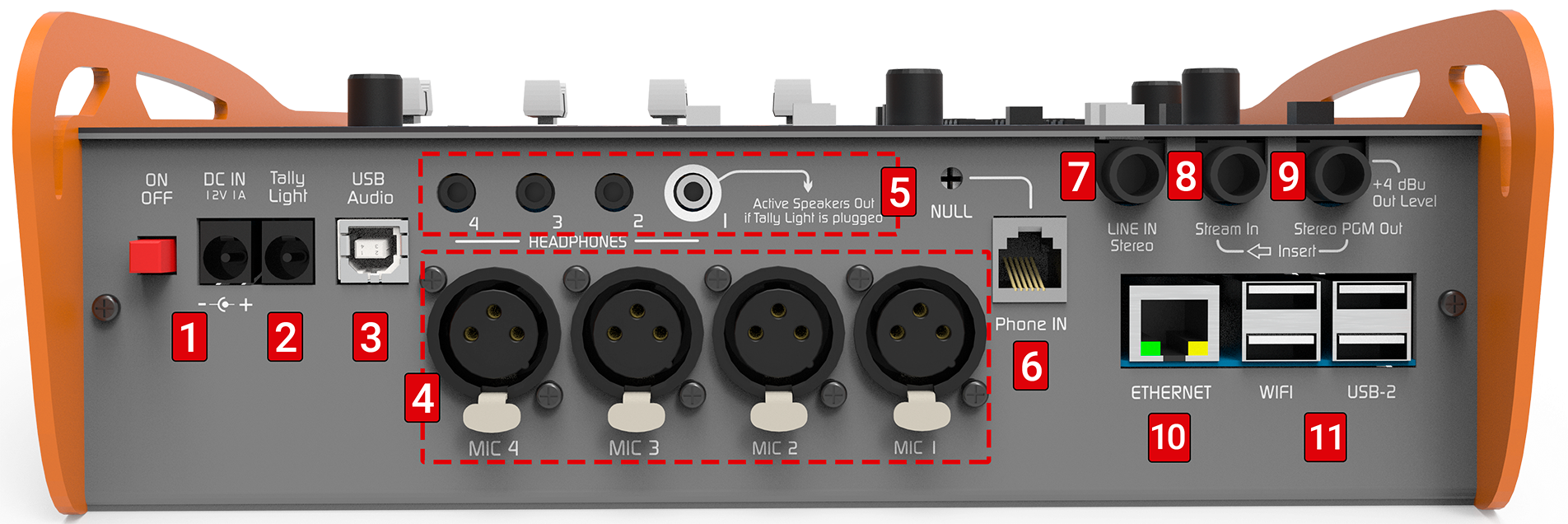
Power Supply (1)
- External power input: 2 mm barrel connector (pin +).
- 90/240 V switching power supply → output 12 V / 1.5 A.
- Also accepts an external 12 V battery (observe polarity).
- Internal battery: approx. 4 hours of autonomy (SIP call via Ethernet, without Wi-Fi or Bluetooth).
- Recharging: performed with the unit powered on and connected to the external power supply.
- Full charge time (from a fully depleted battery): 10 hours.
On-air Light (2)
- 2.5 mm barrel connector (pin +).
- Provides 12 VDC, supports up to 200 mA.
- When an on-air light is connected:
- The headphones #1 output switches to behave as a monitor output.
- It is automatically muted when the microphones are activated, to avoid feedback.
USB Audio (3)
- Digital connection to the computer via USB A/B cable (use the provided cable).
- Recommendation: do not exceed 4 m in length.
- Compatible with Windows 7 through 11, Linux Ubuntu, and macOS (automatic recognition).
-
The system detects:
- USB playback device → LINE USB input on the console.
- USB recording device → audio output from PGM.
In Windows, this can be managed in: Control Panel → Sound → Audio → selection of playback and recording devices.
Microphones (4)
- Four balanced (XLR) inputs for dynamic microphones.
- MIC 3 and MIC 4 share the same fader.
- Recommendation: use microphones of the same brand and model on shared inputs.
Headphones (5)
- Four 1/8” (minijack) TRS outputs.
- All deliver the same level, controlled by the CUE MONITOR knob.
- Output #1 can be used as a monitor speaker output:
- It is automatically muted when an on-air light is connected and activates when microphones are sent to PGM.
Land line (POTS) (6)
- RJ11 connector for POTS line connection.
- Can be connected directly to the public telephone exchange or to a PBX (private branch exchange).
- Internal surge protection with varistors.
-
NULL preset allows adjustment of the hybrid’s rejection.
Rejection (NULL) Adjustment
It is performed when connecting the console to the line. If the console is disconnected and later reconnected to the same phone line, it is not necessary to repeat the adjustment.
However, it should be readjusted each time it is connected to a different line.1Prepare the signal
Send spoken content to PGM from the computer. If no spoken content is available, you can speak live using the microphones.2Establish a call
Make a call using the land line (PHONE).3Mute the other party
Ask the other end to activate mute or remain silent.
You can call your own mobile phone and mute its microphone.4Listen in CUE
Remove PGM from headphones (PGM button in CUE released). Listen to the line in CUE.5Adjust the NULL preset
Turn the NULL preset until you find the point of minimum return.6Finish
End the communication.
Stereo line input (7)
- Unbalanced 1/4” TRS connector.
- Controlled by the LINE fader when USB is not connected.
- If USB is active, LINE becomes a secondary input (from the PHONE section).
Program Insert (8)
- Stream-In input TRS 1/4” with break contact.
- When connected, replaces the internal mix of PGM on streaming and USB.
- Allows the use of external processors: PGM Out → Processor → Stream-In.
Program Output (9)
- Stereo PGM Out (TRS 1/4”).
- Sends the complete mix: microphones, USB, auxiliary line, and phone lines.
Ethernet (Wired Network) (10)
- RJ45 port for connection to local network.
- Uses:
- Web access for CODEC configuration.
- Internet connection for SIP and streaming.
- Web access to recordings.
- Factory default setting: DHCP enabled.
USB Ports (Wi-Fi and Modem) (11)
- USB 2.0 Type A ports.
- Allow connection of:
- Wi-Fi antenna.
- 4G modem (requires a 1 m extension cable).